
The Move Over Law
Traffic incidents are the number one cause of death for emergency responders nationwide.
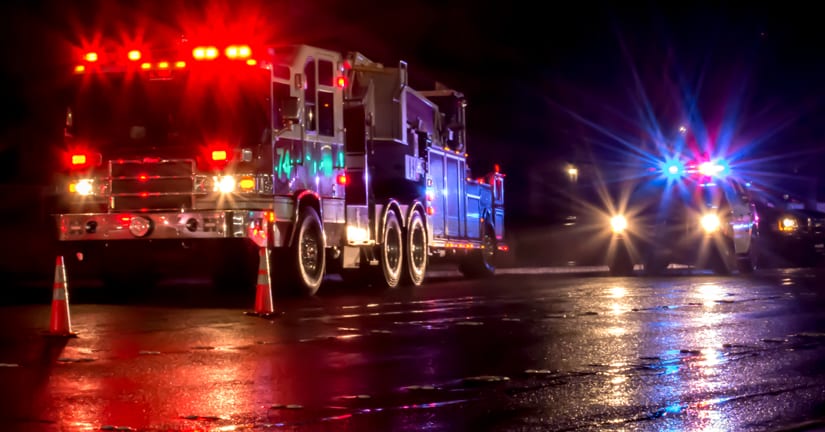
The “Move Over” law in Hawaii was created in 2012 after HPD officers Garrett Davis and Eric Fontes were killed while on duty in separate incidents. The law states, that if an emergency vehicle is stopped and their emergency lights are flashing, drivers are required to move to the adjacent lane. If you cannot move over, drivers are required to slow down to a reasonable speed.
Emergency workers respond to thousands of calls for assistance every month on our roadways and, every one of them out there, can tell you about a crash or a near miss because passing drivers didn’t give them any or enough room to perform their duties. Every single one of these calls could result in a completely preventable tragedy, where innocent people are killed or seriously injured because someone didn’t move over or slow down.
This law helps to protect the people, who risk their lives to serve the community. And as a reminder… the “Move Over” law isn’t just for highways. Drivers are required to move over or slow down for emergency vehicles on surface streets as well.
§291C-27 Emergency vehicle stopped for emergencies; duty of approaching vehicle.
A driver of a vehicle that is approaching an emergency vehicle that is stopped for an emergency, investigation of a possible traffic violation, rendering assistance to a police officer, or other official duties, as indicated by the flashing emergency lights of the stopped emergency vehicle, shall:
- (1) Slow down to a reasonable and prudent speed that is safe under the circumstances of an emergency road situation ahead. If necessary, the driver shall come to a complete stop before making a lane change under paragraph (2); and
- (2) Make a lane change into the adjacent lane if necessary and if it is safe to do so, or if possible, to two lanes over which leaves one lane between the driver and the emergency vehicle.
NOTE: Emergency vehicle means Police, Fire, EMS, Ocean Safety, Freeway Service Patrol, tow trucks and even some state and county vehicles while personnel are working.
Penalty: Court Summons Citation
Click here to for the full description of the Hawaii law.
External Resources
Child Passenger Safety Law
§291-11.5 Child passenger restraints.
On June 27, 2022 a new Child Passenger Safety Law (Act 122) took effect. Act 122 amended requirements for child passenger restraint by requiring rear facing child safety seats for children less than two years of age and increased the age through which a child must use a child passenger restraint or booster seat to 10 years old.
- If the child is under two years of age, the child must be properly restrained in a rear-facing car seat with harness.
- If a child is two years or older but less than four years old, the child must be properly restrained in a rear-facing or forward-facing car seat with harness.
- All children under ten years old must be properly restrained regardless of how many seat belt assemblies are in the vehicle.
- Violators of the law will be required by the court to attend a child passenger safety class approved by the Hawaii State Judiciary.


Penalty: Court Summons Citation
Click here for the full description of the Hawaii law
External Resources
For more information on child passenger safety and for information on local child safety seat inspection sites, please visit the Keiki Injury Prevention Coalition website at www.kipchawaii.org
https://hidot.hawaii.gov/blog/2022/07/06/new-child-passenger-safety-law/
https://hidot.hawaii.gov/highways/safe-communites/child-passenger-safety/
Operating a Vehicle Under the Influence of an Intoxicant (OVUII)
§291E-61 Operating a vehicle under the influence of an intoxicant.
A person commits the offense of operating a vehicle under the influence of an intoxicant if the person operates or assumes actual physical control of a vehicle:
- While under the influence of alcohol in an amount sufficient to impair the person’s normal mental faculties or ability to care for the person and guard against casualty;
- While under the influence of any drug that impairs the person’s ability to operate the vehicle in a careful and prudent manner;
- With .08 or more grams of alcohol per two hundred ten liters of breath; or
- With .08 or more grams of alcohol per one hundred milliliters or cubic centimeters of blood.
Penalties:
- Arrest
- Criminal Record
- Loss of a Driver’s License
- Fees & Fines
- Mandatory attendance of Substance Abuse Programs
- Serious bodily injury and/or loss of a human life
Click here for the full description of the Hawaii law
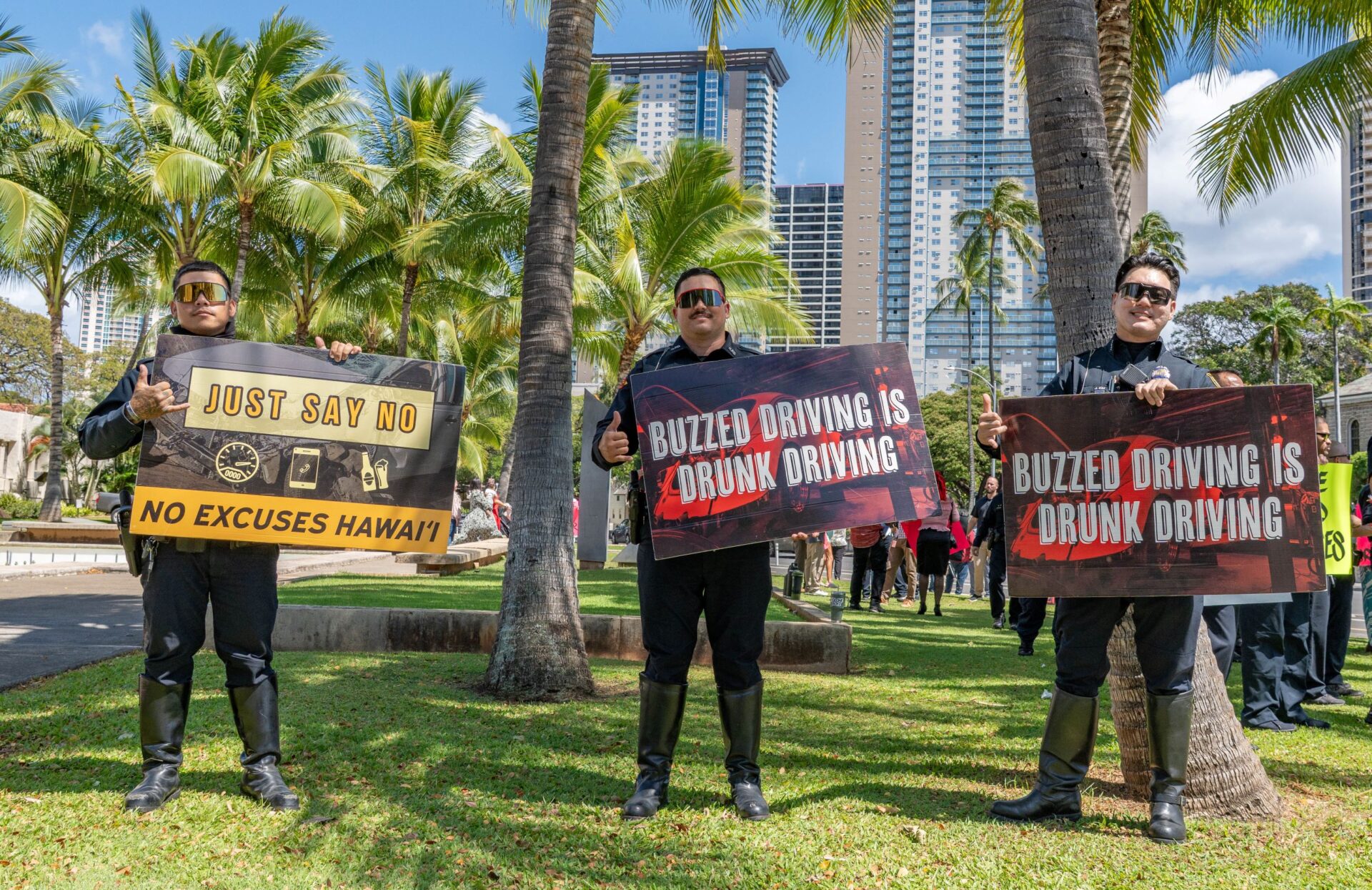
In 2024, HPD investigated 56 traffic fatalities. An overwhelming 36 of them were related to some form of impairment.
In that same time period, The Honolulu Police Department apprehended 1,509 drivers for Operating a Vehicle Under the Influence of an Intoxicant (OVUII).
Please remember to never operate a vehicle if you are impaired. Book a ride share, predesignate a sober driver, or stay over at the location if you consume anything that will affect your ability to operate a vehicle safely. To learn more, please visit the following websites.
External Resources
Moped Laws
§291C-194(a) Driver’s License Required.
Click here for the full description of the Hawaii law

§291C-195(a) Underage Operation of Moped.
No person shall operate a moped under the age of 15 years.
§291C-195(c) No Passengers
No person shall drive a moped, which is carrying any other person, nor shall any person other than the driver ride upon a moped.
Click here for the full description of the Hawaii law
§291C-196(c) Moped Prohibited on Sidewalks / Pedestrian Areas.
No person shall drive a moped on any sidewalk or area intended for use as a sidewalk, or any other path intended for pedestrians.
Click here for the full description of the Hawaii law
§291C-197(a) Driving Mopeds on Bicycle Lanes and Paths.
Wherever bicycle lanes are provided on the roadway, moped drivers shall use such bicycle lanes.

§291C-199 Clinging to Vehicles, Bicycles & Etc.
No person driving a moped shall attach oneself or the moped to any vehicle, nor permit anyone to become attached to the moped or the driver.
Mandatory Seatbelt Law
In 2023, nationally, 23,959 passenger vehicle occupants were killed. Nearly 50% of those were not wearing seatbelts . Seat belts save lives, so fasten yours and make sure your passengers do too!

§291-11.6 Mandatory Use of Seat Belts.
No person shall operate a motor vehicle upon any public highway unless the person is restrained by a seat belt assembly and all passengers in the front and back seat of the motor vehicle are restrained by a seat belt assembly.
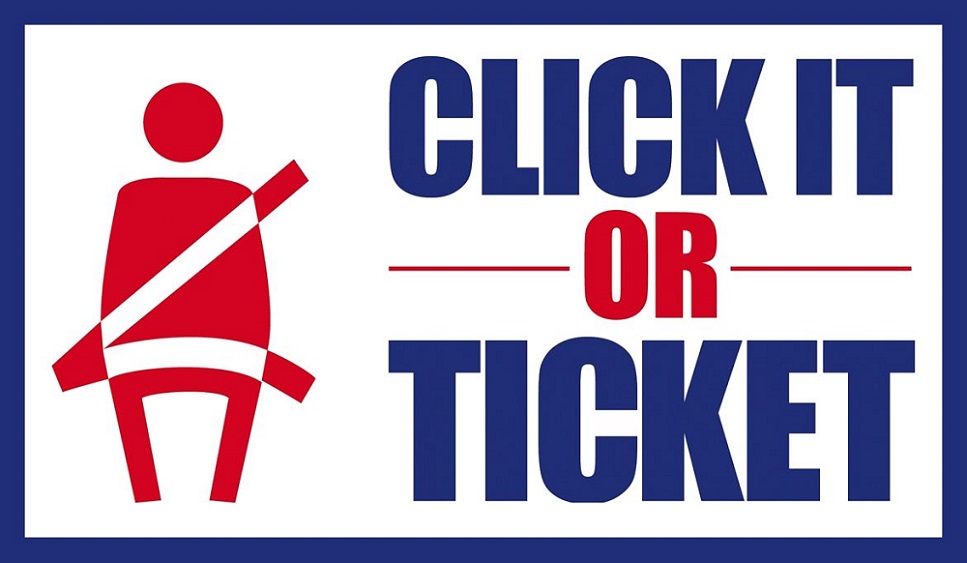
Click It or Ticket is an annual National Enforcement Campaign to crack down on seat belt nonuse and to reduce highway fatalities. The program started in North Carolina in 1993. By 2004 the program the program reached all 50 states and the US Territories.
Watch National Highway Traffic Safety Administration Click it or Ticket video here.
Penalty: $102 fine (per occupant not wearing a seatbelt)
Click here for the full description of the Hawaii law
External Resources
Speed Kills
On average, excessive speed is a contributing factor in approximately half of Oahu’s traffic fatalities every year. Please obey posted speed limits and drive safely!
Penalties
| Violation | Penalty |
| Speeding 1-10 mph over the posted limit | $62 + $5/mph over |
| Speeding 11-29 mph over the posted limit | $122 + $5/mph over |
| Basic Speed Rule | $157 |
| Exhibition of Speed | Court Summons |
| Excessive Speeding (30mph and above over the posted limit) | Court Summons |
| Excessive Speeding (81mph and above over the posted limit) | Court Summons |
| Racing | Arrest or Court Summons |
| Reckless Driving | Arrest or Court Summons |
| Negligent Injury | Up to 5 years in prison |
| Negligent Homicide | Up to 10 years in prison |
Street Racing
In 2024, Honolulu Police Department Officers arrested 422 drivers for Street/Highway Racing, as well as Excessive speeding on roadways. Some of them could not be arrested as they became a fatality statistic or sustained serious/critical injuries.
Please think about your life, and the life of everyone around you. Slow down, and arrive alive.
External Resources
Mobile Electronic Device
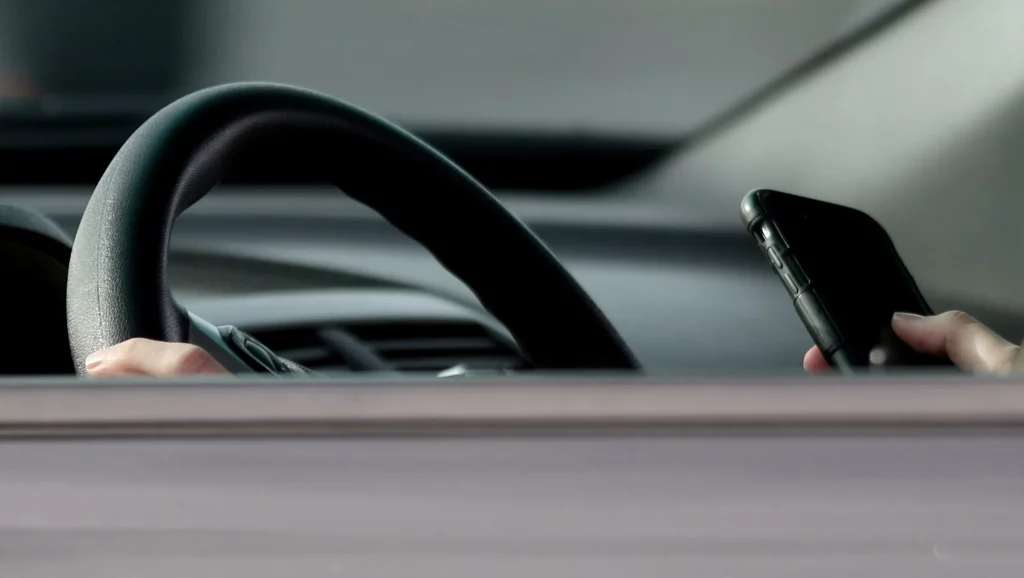
§291C-137 Prohibited Use of Mobile Electronic Devices.
- No person shall operate a motor vehicle while using a mobile electronic device
- The use of a mobile device is only legal for the sole purpose of “911” emergency communication.
- No person under eighteen years of age shall operate a motor vehicle while utilizing a hands free mobile electronic device.
- Driver can use a mobile electronic device ONLY if their vehicle is at a complete stop, while engine is turned off and in a safe location away from other traffic lanes.
Click here for the full description of the Hawaii law
ROH 15-24.23 Mobile Electronic Devices – Pedestrian.
- No person shall cross a street or highway while viewing a mobile electronic device.
Click here for the full description of the Hawaii law
Penalties
On July 1, 2022, Hawaii passed a new Legislature Bill H.B. NO. 1692, that increased the fines of the violations related to Mobile Electronic Device law.
| Operate Motor Vehicle with Mobile Electronic Device | $ 347 |
| Operate Motor Vehicle with Mobile Electronic Device in School/Construction Zone | $ 447 |
| Operate Motor Vehicle with Mobile Electronic Device under the age of 18 | $ 307 |
| Operate Motor Vehicle with Mobile Electronic Device under the age of 18 in School/ Construction Zone | $ 407 |
| View a Mobile Electronic Device while crossing a street/highway | Court |
External Resources
Oahu Collision Statistics
In 2024 there were 56 traffic related fatalities. 36 were Alcohol or Drug related and 20 involved speeding.
18 fatalities were pedestrians, 12 were operating a motorcycle, 12 were vehicle occupant, 5 were operating mopeds, and finally 6 were bicyclist.
As a community, we need to share the road and look out for one another. Please remember to be Akamai and to drive with ALOHA.

Oahu Move Over Law violation tragedies
September 2011: Officer Eric Fontes killed in the line of duty on Farrington Hwy.
January 2012: Officer Garrett Davis killed in the line of duty on H1 East.
January of 2020: Tow truck driver was killed while helping a motorist on H2 North.
August of 2021: A passenger of a vehicle that collided with a stopped police vehicle on H1 East died.

Disabled Parking Enforcement Program
The Disabled Parking Enforcement Program comprises of volunteers from around the island under direct supervision of the Honolulu Police Department Officer.
Volunteer Special Enforcement Officers assist Honolulu Police Department with enforcement of disabled parking laws.
Volunteers patrol near their home, get paid mileage and work flexible schedule. HPD provides FREE uniforms and equipment. We just ask for a minimum of 20 hours per month or 5 hours per week.
Requirements for Volunteers
Interested in becoming a volunteer? You must:
- Be a United States citizen
- Be resident of the city and county of Honolulu
- Be least 21 years of age
- Be a high school graduate or hold an equivalent GED certificate
- Possess a valid State of Hawaii driver’s license
- Pass a criminal history and background investigation
- Complete an oral interview
- Meet the qualifications for a Special Police commission.
Contact Information
If you are interested in volunteering or want more information, call HPD’s Disabled Parking Enforcement Program Office at (808) 723-3398.